Working with Artists
BEST PRACTICES
View 6 Guiding Tips +
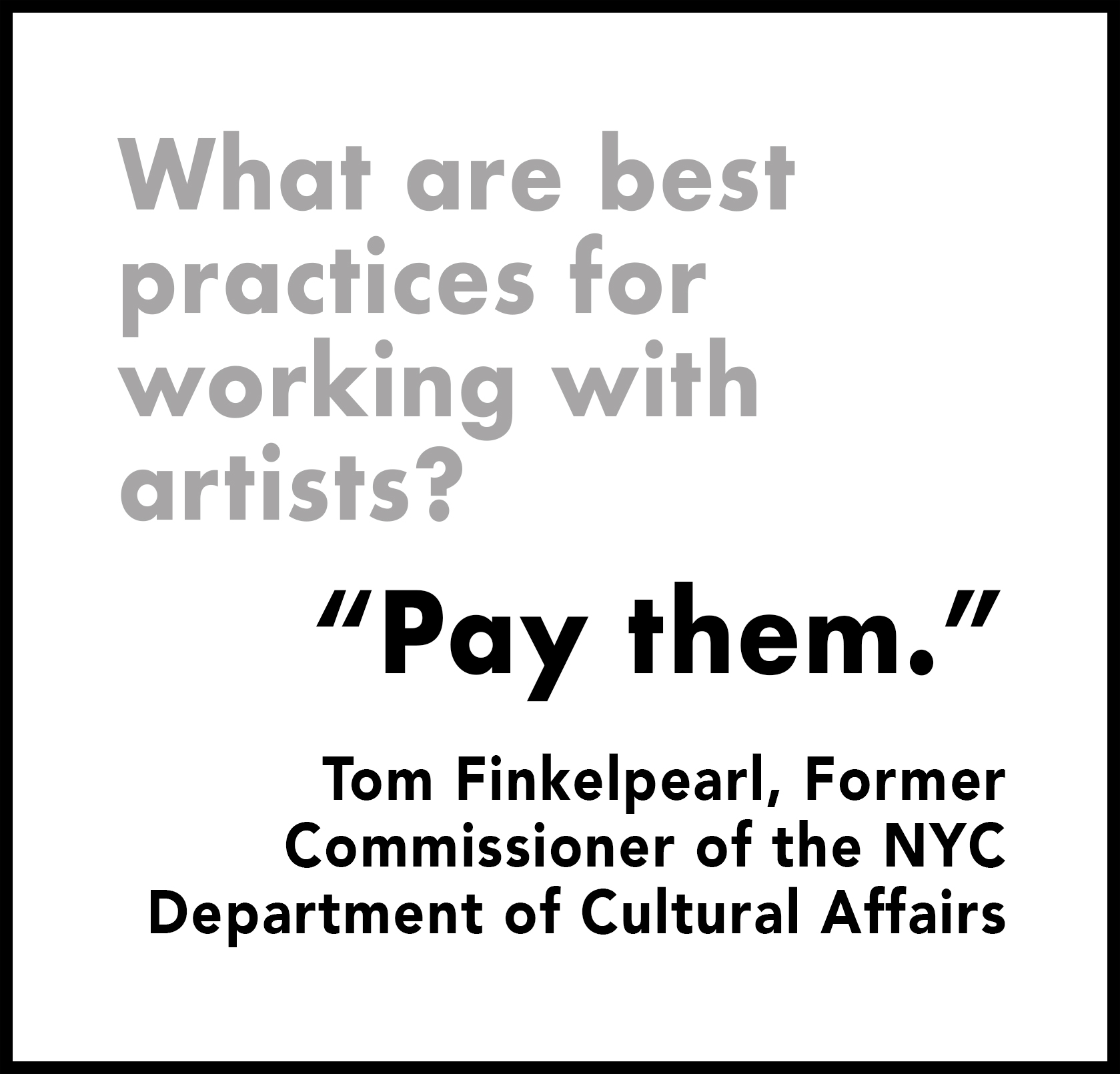
- Pay artists as you would any other highly skilled professional. They should not be considered an entry-level worker or one that should merely be given a token fee.
- Approach the relationship with clarity, trust and mutual respect.
- Agree ahead of time on the scope of work, terms and conditions, payment schedule, and any other expectations. Include in the agreement any need for preliminary sketches and the ability to make a limited number of revisions as creative work usually requires some back and forth.
- Any work beyond the original scope should be discussed for scheduling impact and additional costs.
- Both sides should adhere to agreed upon deadlines.
- Consider out-of-pocket expenses as extra costs, and acknowledge there may be sunk costs the artist has incurred that impacts their pricing: e.g. specialty materials, tools, software, etc.
PRACTICES TO AVOID
View 9 Common Habits +
- Asking an artist to work just for “exposure.”
- Hiring an artist to save money because you plan on only offering a small stipend. This keeps many artists from even applying, so quality and quantity of applicants will be impacted negatively.
- Holding contests with the goal of receiving an abundance of free/cheap work samples.
- Asking artists to donate work to a fundraising benefit without their being able to set a minimum bid or have the possibility of sharing in the sales profits. (NB: they cannot receive any tax benefits for this donation past the costs of materials.)
- Charging income-generating application fees. Serious artists won’t “pay to play.”
- Using a business model that makes money off of artists’ content, but doesn’t pay them for it.
- Creating applications that are so cumbersome that any potential award is already subsumed by the hours needed to write and submit the proposal.
- Making deadlines that don’t reflect a realistic turnaround or are unnecessarily onerous (e.g. a Friday night deadline, a national holiday, etc.)
- Requiring letters of reference when they aren’t a determining factor. Artists regularly have to tap colleagues and use up goodwill for unnecessary recommendations.
If in doubt, ask the question: would I expect a non-artist worker with a similar level of expertise to agree to the job/payment/scenario in question?
REASONS TO WORK WITH ARTISTS +
Artists are problem solvers. Their creativity is a specialty unto itself that can be broadly applied and even help others uncover solutions to complex issues or problems. Artists are good at asking unusual questions, and both receiving and offering critical feedback.
Artists are communicators. Artistic work is a translation of complex ideas into forms that can be understood by a larger audience. This desire to share and interact with their community lends artists to be natural facilitators, often for groups that may have difficulties understanding each other. Art brings empathy to the table and serves as a point of connection to build upon.
Artists are experts in their fields, and often have advanced degrees, or the equivalent in related work hours. Creativity can be innate, but any successful creator has also spent significant amounts of time honing their skills. This passion and focus can make creative work look “easy” and lead to the misguided notion that artists should do projects for free because it seems “fun” for them. Instead, consider them as you would a high-level athlete who makes their sport look effortless.
Artists are often best brought into a project early – at the development phase. They will offer innovative ideas and entertain questions at a stage when such things can still be incorporated. If you have a project intended for an artist, but design a majority of it without their input, they will be left doing the best they can with someone else’s set of uninspired or standardized guidelines. This does both sides a disservice as the artist’s expertise is not fully being utilized.
TIPS FOR BUSINESSES & ORGANIZATIONS +
- If you have a project in which workers – staff, vendors, consultants – are paid, you should also be paying any involved artists. Build these costs into your budgets as you would for anyone else.
- If your constituents are artists, do not make them feel they owe you financial support in the form of monetary or artistic donations. Even though they are benefitting from your mission, your organization exists because of them as well – it works both ways.
- There are additional ways to be generous with artists beyond money. As sole practitioners, they may not have liability insurance, engineering support, or a large social media/communications outreach. Sharing such perks, as appropriate for the work, allows them to focus on the creativity.
It’s also important to understand:
Artists have a lot in common with small business owners, but they are not identical. Both may be passionate about what they do with a drive to succeed through professional recognition and earning income. But for many artists, art is so integral to how they live and perceive the world that there is no option to stop making art even if it is not proving to be financially successful.
Many artists instead pursue alternative jobs in order to underwrite their art careers. Even artists who the layperson would assume are doing well – touring musicians, exhibiting visual artists, published authors – are often making ends meet through other sources of income. Such is the nature of support for culture. Does that mean that their work is not of a very high caliber? No. It means that sources of direct income are few and far between.
When an artist does a project for you they still own the copyright, particularly for visual art – even if the work is in your possession or on your property. Physical ownership is not the same thing as copyright ownership. For instance, you cannot use an image of a commissioned mural to put on sellable merchandise or even use the image prominently in advertising without the artist’s permission.
Work for hire, which transfers copyright to someone else, needs to be contractually negotiated in writing, and only pertains to certain limited situations* and usually entails higher payments.
Similarly, the intellectual property (IP) of an artist’s project remains theirs even if you helped finance or otherwise offered support for the project. It is appropriate to ask for a credit listing to indicate your funding for the project, but the IP ownership still remains that of the artist.
TIPS FOR ARTISTS +
- Doing work for little or no pay rarely benefits you, and can also perpetuate unsustainable standards that keep your fellow artists from being paid their worth as well.
- Be willing to point out when a situation is unbalanced. Oftentimes the business or person in charge didn’t consider or understand how much work they are asking you to do, and at what sacrifice.
- If you are working with other artists, share the wealth. If you are getting paid, you should also pay those you are asking to work with you on your project.
PARTNERSHIP TIPS
FOR EVERYONE
By Future Culture Policy Fellow Ben Margolis
Future Culture provides a road map for the community to proactively engage in and shape the North Shore of Staten Island’s cultural, social and economic development. This community’s unique lens, approach, and network can and must be fully accounted for. Throughout the project, the community clearly stated that the North Shore should not be looked upon as a “blank slate”, or that it is in need of “transforming”. In other words, current and future development should be additive and build upon the unique mix of people, culture and amenities that already exist. Read More +
Ensuring this means that the community must go beyond simply enhancing on already-established municipal or private development plans.
While local organizations will generate the needed people-power and momentum to develop Future Culture initiatives, they will also require additional funds, appropriate staffing capacity, and other stakeholders – especially landowners and developers, both public and private – to facilitate, manage and ensure implementation.
To help ensure this, a few ideas for acquiring the necessary knowledge, engagement and partnerships with both public and private actors are offered below. At its heart, an “Artist-Development framework” could help developers and municipal officials to began to think like artists, and artists begin to proactively think like developers and decision-makers.
Learn More About Your Community to Identify Opportunities +
A quick example is looking at trends associated with age. And this is particularly relevant for the North Shore. In 1970, Staten Island had the youngest median age among the five boroughs. By 2030, it will have, by far, the oldest. Due to aging in place, the borough’s senior population is growing the fastest. And while the young adult population (20-34 years) is growing, they are leaving Staten Island for other parts of the region. These trends are behind the willingness for private developers to invest in projects like the New Stapleton Waterfront (formerly “Homeport”). They are building housing units that will work for both young professionals and seniors. In response and in anticipation of more development, the North Shore cultural community could consider prioritizing programs for these two populations.
What other trends must be understood? And how do they potentially provide needed investments in, and opportunities for culture to help unlock, the unique economic and physical assets of North Shore communities?
Several City agencies – including the NYC Department of City Planning (Staten Island Borough Office) and the NYC Economic Development Corporation (Development and Planning Division; Strategic Planning Division) – often release demographic reports on Staten Island and North Shore neighborhoods. Cultural stakeholders could (and should) regularly request, and help shape, new information on the communities that they serve.
Understand (and Anticipate) Potential Development and Investment Sites +
In the implementation of pilot and future cultural projects, it will be necessary to have a clear and foundational understanding about these drivers, but also:
- jurisdiction of waterfront and public land (who controls what);
- cost and sources of funds for physical improvements; and
- approval processes for current and future development projects
With an understanding of developer goals and key information, the North Shore cultural community can anticipate which sites are slated for future development, and the scale and timing of development plans for those sites. (It could also proactively propose development ideas!).
While Future Culture has worked to identify both a range of investment opportunities for catalyst sites, and potential / creative sources of funding to address fundamental issues, the North Shore cultural community must continue this work.
After considering the economic and emotional importance of a site, the local cultural community has an opportunity to play a major role in its re-envisioning and redevelopment. How can it specifically help shape future proposals? How can culture help activate sites and provide needed community amenities?
Engage in the Development Process +
In addition to the $1.2 billion of public and private investment from current / initial phases of North Shore projects, more development is being contemplated – the City’s Bay Street Corridor Rezoning could potentially lead to another 2,500 residential units; the redevelopment of the Jersey Street Sanitation Garage can lead to more direct cultural engagement with underserved and distressed communities; the next phases of the New Stapleton Waterfront project will bring major waves of development on public land. Request for Proposals (RFPs) and subsequent approval processes for the next phases of public development projects will bring additional opportunities and challenges for the North Shore cultural community.
A major thrust for the Future Culture project is connecting North Shore communities to the ongoing development and investment process. But there is a difference between participation and meaningful engagement – knowing what to leverage and when – to help ensure ongoing planning processes and developments will directly address the unique needs of North Shore communities.
Immediately, the degree that the proposed Bay Street rezoning, and subsequent commitments from the City, will provide incentives for the creation of visual and performing arts space and for enhancing the area’s role as a major arts, entertainment and cultural destination, is still to be determined. But it is clear that the community’s proactivity has already made a difference. That must continue and increase.
The Future Culture process highlighted clear priority areas for advocacy and engagement, such as artist workspace and housing. Increasing development pressure and rising rents have made New York City an exceedingly challenging place for those in the arts and creative industries not only to find and to keep affordable space for working and presenting, but for living. The Bay Street Corridor Plan – and other future rezonings – could be leveraged to incentivize much-needed living and workspace (maybe even “Work-Live Space”). Considering its importance to the revitalization and future of the area, the North Shore cultural community should be guaranteed a certain percentage of future space.
As Future Culture partners and participants further engage in a last chapter of the Bay Street Plan, what lessons can be learned from the City’s process in other neighborhoods? Other rezonings around the City have used a mix of City money and some portion of a citywide pot in federal funds to:
- help local arts organizations bolster their membership and fundraising;
- help speed up government permits so they can employ underused spaces; and
- formalize a committee structure in each neighborhood for groups to communicate, collaborate, and leverage resources to better engage local audiences.
Making the case for these and further types of support requires anticipating challenges for the City (who is an “artist”?) and providing solutions (artist certification programs) versus waiting for solutions to be presented.
Looking for Potential Partners? View Possibilities.